

How to Identify Genuine Leather: The 2026 Guide to Spotting Real Quality
That "Genuine Leather" stamp on your premium bag might actually be the industry's cleverest way of telling you that you're buying the lowest grade of hide available. In 2026, market data suggests that 74% of products marketed under vague leather labels are actually bonded scraps or plastic-coated synthetics. You want to know how to identify genuine leather to ensure your money goes toward a timeless investment rather than a "vegan" alternative that won't last 12 months. It's natural to feel anxious when marketing terminology obscures the truth about the craftsmanship you're holding.
We believe you deserve the clarity of a seasoned artisan. This guide will teach you the art of distinguishing premium hides using expert-led techniques that rely on your senses rather than destructive tests. You'll gain the confidence to bypass marketing traps and recognize the handcrafted quality that defines a true luxury piece. We are going to break down the three specific scent profiles, the irregular pore patterns, and the edge fibers that separate a 10-year investment from a synthetic imitation.
Key Takeaways
- Uncover the truth behind the "Genuine Leather" label and learn to navigate the hierarchy of premium hides, from top-grain to high-grade technical tiers.
- Master how to identify genuine leather using sensory cues like the "Imperfection Principle" to distinguish authentic hides from uniform synthetic imitations.
- Gain the confidence to perform practical home assessments, such as edge analysis and moisture tests, to verify the presence of real collagen fibers.
- Bust common myths about leather "perfection" and discover why natural markings are actually a hallmark of high-quality, handcrafted craftsmanship.
- Learn why investing in 100% full-grain cow leather ensures the timeless sophistication and long-term durability that defines a true luxury investment.
The 'Genuine Leather' Label: Why It’s Often a Marketing Myth
When you see "Genuine Leather" stamped on a belt or bag, you likely assume it is a seal of premium quality. This is the industry's most misunderstood marketing term. In the world of luxury craftsmanship, "Genuine" does not mean "the best"; it actually refers to a specific technical grade that ranks near the bottom of the quality scale. For decades, manufacturers have used this ambiguous phrasing to mask lower-quality split leathers that lack the natural strength of the hide's upper layers.
By the 2026 standards for luxury transparency, savvy consumers now look beyond the surface. Understanding how to identify genuine leather starts with recognizing that this label often identifies products made from the leftovers of the tanning process. These items are frequently corrected with heavy pigments or artificial grains to mimic the appearance of superior hides. At Laveri, we believe that true sophistication requires knowing exactly what you are investing in.
Deconstructing the Grades of Leather
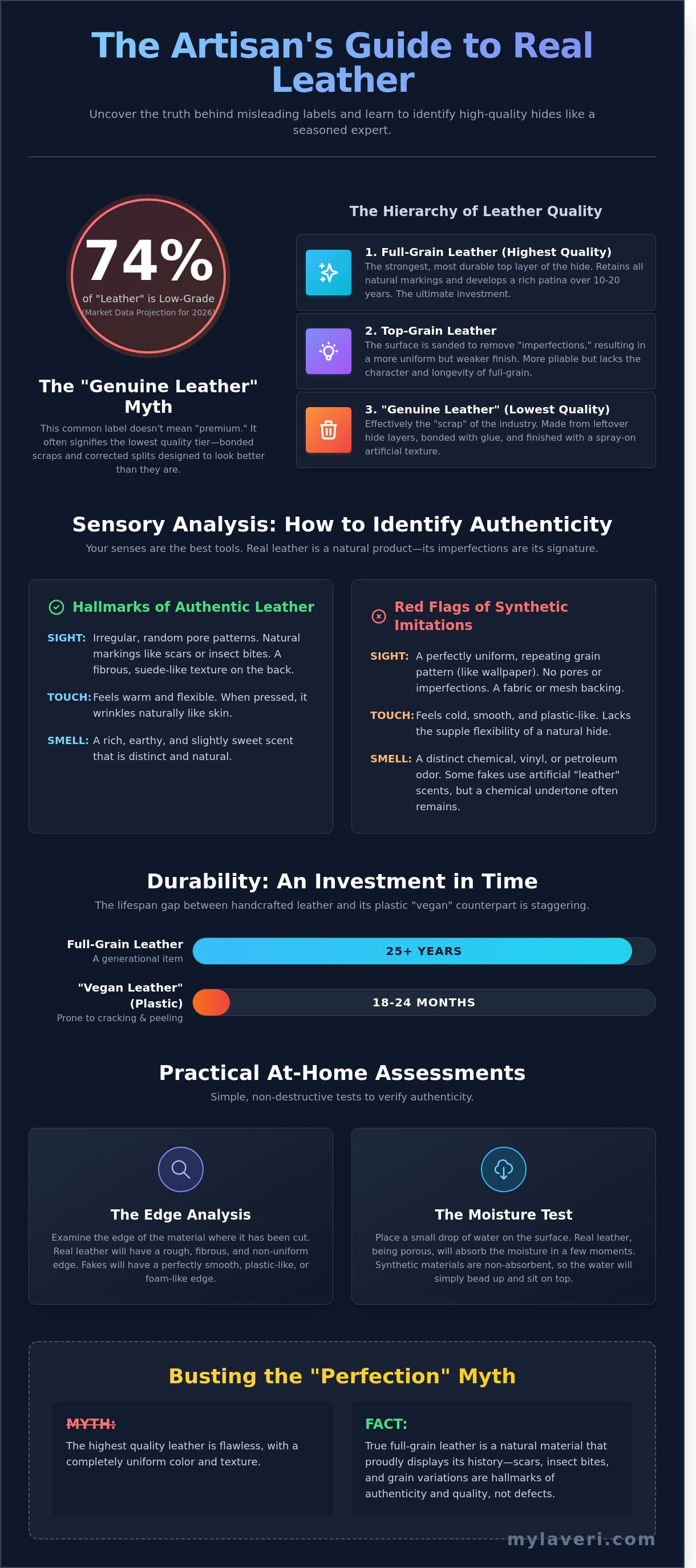
- Full-Grain Leather: This is the strongest and most durable layer of the hide. It remains unblemished by sanding or buffing, allowing the natural grain and fibers to stay intact. It develops a rich patina over 10 to 20 years of use.
- Top-Grain Leather: This tier is slightly thinner and more flexible. The surface is sanded to remove natural "imperfections" like scars or insect bites. While it offers a uniform look, it lacks the long-term character of full-grain.
- Genuine Leather: This is the third-tier leftover from the Leather production processes that split a single hide into multiple layers. It is functionally the "scrap" of the leather world, often bonded together with glues and finished with a spray-on texture.
Why 'Vegan Leather' is a Misnomer
The term "vegan leather" is a clever rebranding of synthetic materials, primarily Polyurethane (PU) or Polyvinyl Chloride (PVC). While these materials avoid animal products, they are essentially plastic. The durability gap is staggering; a handcrafted leather wallet can easily last 25 years, whereas a plastic alternative typically begins to crack and peel within 18 to 24 months. Furthermore, the environmental impact of microplastics in synthetic hides presents a significant contrast to the biodegradable nature of high-quality animal skins. Learning how to identify genuine leather involves feeling for the warmth and breathability that plastic simply cannot replicate.
Sensory Analysis: Identifying Real Hides Through Touch, Sight, and Smell
Authenticity isn't just a label; it's a sensory experience. To master how to identify genuine leather, you must look past the surface. Real hides are biological products that carry the history of the animal. This means they're inherently inconsistent and unique. If a product looks too perfect, it's usually because it is.
The "Imperfection Principle" is your first line of defense. If a hide shows 100% uniform patterns across its entire surface, it's a red flag. Nature doesn't work in perfect grids. Genuine full-grain leather contains irregular pore distributions from hair follicles. These tiny pits are scattered randomly. Synthetic alternatives often use a repeated stamping plate, usually every 15 to 20 centimeters, which creates a telltale mechanical pattern that repeats like wallpaper.
Don't rely solely on the "new leather" smell. By 2025, market data showed that over 35% of synthetic manufacturers began using micro-encapsulated "leather" scents to trick consumers. While a real hide smells earthy and rich, a fake often retains a faint chemical undertone of petroleum or glue. Trust your hands and eyes more than your nose when checking for quality.
The Visual Inspection: Pores and Grain
Use your phone's zoom to examine the surface. In a 1-centimeter square of premium cowhide, you'll see varied grain depths and tiny, irregular pores. If the surface looks like it was printed with a digital printer, it's likely "corrected grain" where the natural top layer was sanded off. Look for the rough, fibrous back of the material. Real leather doesn't have a fabric or mesh backing; it has a dense, suede-like texture that's part of the hide itself.
The Haptic Experience: Flexibility and Warmth
Real leather is a natural insulator. If you touch a handcrafted leather bag, it will absorb and match your body heat within 5 to 8 seconds. Synthetics stay cold and feel rubbery or "plastic-y" to the touch. Try the "Wrinkle Test" by pressing your thumb firmly into the surface. Real leather creases like human skin, creating tiny, radiating lines. When you release the pressure, those lines disappear as the fibers settle. Synthetics simply dip under your thumb without changing the surrounding texture. This simple test is one of the most reliable ways to understand how to identify genuine leather in a retail environment.
Practical Home Tests to Confirm Leather Authenticity
You don't need a laboratory to verify the quality of a premium investment. Genuine hide is a biological material, and its reaction to simple elements like water, pressure, and weight reveals its true origin. When you're learning how to identify genuine leather, focus on the material's physical response rather than just the price tag.
Non-Destructive Tests for Luxury Items
Authenticating a high-end bag requires methods that won't damage the finish. Real leather is naturally porous because of its original pore structure. If you place a single drop of water on a full-grain surface, the material will typically absorb the moisture within 15 to 30 seconds. On synthetic PVC or PU materials, the water beads up and sits on the surface indefinitely. This absorption happens because the collagen fibers remain open to the environment.
- The Bend and Change Test: Pull-up leathers are treated with oils and waxes. When you bend the leather, the oils displace, creating a temporary lightening of the color. This sophisticated "marbling" effect is impossible to replicate in plastic.
- Stitching Hole Inspection: Examine the needle entry points under a magnifying glass. Real leather holes look slightly irregular and fibrous. In synthetic alternatives, the heat of the sewing needle often leaves a slightly melted, perfectly smooth rim around the hole.
What the Edges Reveal About Construction
The cross-section of a strap or pocket provides a clear map of the material's history. Premium handcrafted goods often feature "raw" edges where you can see the dense, fuzzy fibers of the hide. If the edge feels like smooth plastic or looks like a sandwich of different materials, it's likely "bonded" leather. Bonded products often contain only 10% to 20% leather scraps held together by 80% polyurethane glue.
Pay close attention to the color of the edge. A distinct blue or grey tint in the center of a cut edge indicates an incomplete tanning process. This "wet blue" core means the tannins didn't penetrate the full thickness of the hide, which can lead to cracking within 12 to 18 months of use. Understanding these structural details is also essential when you learn how to clean leather bag edges, as raw fibers require different care than sealed, painted ones.
The Weight and Oil Factors: Genuine cowhide is remarkably dense. A high-quality leather messenger bag usually weighs between 1.2 and 1.8 kilograms. If a large bag feels suspiciously light, it's likely a synthetic laminate. Additionally, real full-grain leather will absorb natural oils. If you apply a tiny dab of leather conditioner and it disappears into the grain, you've confirmed the presence of an authentic, breathable cellular structure.
Busting Common Myths About 'Perfect' Leather Goods
Many shoppers believe that a flawless, glass-smooth surface indicates high quality, but the opposite is often true. If you want to know how to identify genuine leather, you have to look for the "imperfections" that tell a story. Authentic hides aren't produced in a sterile factory; they come from animals that lived outdoors. Small scratches, subtle stretch marks, or neck wrinkles are signatures of a premium product. In contrast, 100% uniform patterns often signal embossed plastic or heavily corrected grain where the natural character has been sanded away.
Price is another misleading factor that traps many consumers. A $600 price tag doesn't guarantee a full-grain hide. Marketing budgets and designer logos can inflate costs by as much as 400% without improving the raw material quality. Similarly, the idea that real leather must be stiff and uncomfortable is outdated. While traditional vegetable-tanned items require a break-in period, modern artisan techniques produce buttery-soft, handcrafted bags that feel luxurious from the very first day.
The Danger of the Fire Test
Holding a lighter to a luxury wallet is a destructive and unreliable way to verify its origin. This test is often inconclusive because 90% of modern synthetic leathers are treated with fire-retardant coatings that mimic the way real hide reacts to heat. Real leather chars and smells like burning hair, but a flame will ruin the protective oils and finish of a premium item. Luxury brands like Laveri advise against heat-based testing because it causes permanent, unnecessary damage to the structural integrity of the grain.
Understanding Natural Patina
A product that looks exactly the same after three years of use is likely a synthetic imitation. Real, high-quality leather evolves over time. It absorbs oils from your hands and exposure to sunlight, developing a rich, darkened sheen known as patina. This process is a hallmark of full-grain cow leather where the fibers remain intact. When considering how long does leather last, remember that a 20-year lifespan is standard for well-maintained goods. The aging process isn't a sign of wear; it's the mark of a smart, stylish investment that gains character as it ages.
Why Handcrafted Full-Grain Leather is the Ultimate Investment
Choosing full-grain leather is a decision rooted in biological durability. Premium hides consist of dense, long-chain collagen fibers that haven't been weakened by heavy sanding or chemical thinning. This natural structure allows the material to breathe and develop a unique patina that improves with age. While synthetic alternatives often begin to crack or peel within 12 to 18 months, 100% Cow Leather remains structurally sound for 20 years or more. Mastering how to identify genuine leather is a vital skill for any smart investor looking to escape the cycle of disposable fashion.
The "Cost Per Wear" logic proves that quality is the more economical choice. A single handcrafted bag might have a higher initial price, but it outlasts five synthetic alternatives easily. If a 1,500 AED bag lasts 15 years, your annual cost is only 100 AED. In contrast, replacing a 400 AED synthetic bag every year leads to much higher long-term spending. Skilled artisans play a critical role here by selecting the strongest sections of the hide, ensuring the natural integrity of the leather isn't compromised during the stitching process.
The Laveri Commitment to Quality
Laveri uses only Full-Grain Genuine Leather to ensure every piece meets the highest standards of luxury. We avoid mass production because machines often ignore the subtle variations in a hide that require an artisan's touch. Our craftsmen preserve the leather's natural integrity, ensuring that each bag and wallet is as unique as the person carrying it. This dedication to traditional techniques caters specifically to the UAE's discerning market, where approximately 85% of luxury consumers prioritize material authenticity over brand logos alone.
Making the Final Decision
Your approach to leather shopping should always be to trust your senses but verify the source. Transparency from the retailer is the biggest sign of authenticity. Genuine brands don't hide behind vague labels; they celebrate the natural marks and textures of the hide. Now that you know how to identify genuine leather through scent, texture, and grain, you can build a wardrobe that stands the test of time.
Choose Excellence for Your Personal Collection
Identifying a true masterpiece requires more than a glance at a price tag. You now have the tools to look past marketing myths and perform sensory checks that reveal a hide's true origin. Remember that real quality lives in the organic imperfections of 100% full-grain cow leather, a material that develops a unique patina over decades rather than months. Knowing how to identify genuine leather isn't just a skill; it's a way to ensure your wardrobe represents a smart, timeless investment. High-quality hides shouldn't be a mystery. They should be a standard you expect from every premium purchase you make.
At Laveri, we remove the guesswork by using only the finest materials in every handcrafted piece. Our commitment to excellence is reflected in our 4.9/5 Google Review rating from thousands of satisfied clients who value durability. We ship our luxury goods directly from Dubai to your doorstep with reliable international delivery. You deserve a product that stands the test of time and ages beautifully with your journey. Pick a companion that's as resilient and sophisticated as you are.
Think Leather, Shop Laveri: Discover Handcrafted Luxury
Frequently Asked Questions
Does 'Genuine Leather' mean it is 100% real?
The term "Genuine Leather" confirms the material comes from an animal hide, but it typically represents the third or fourth grade of quality. While it's 100% real, it lacks the durability of premium cuts because it's made from the remaining layers after the top is stripped away. At Laveri, we prioritize the top 5% of hides to ensure your investment lasts for decades rather than just a few seasons. This commitment to quality ensures every piece reflects the sophistication you deserve.
Can you tell if leather is real by its smell?
You can identify real leather by its rich, earthy aroma that synthetic alternatives cannot replicate. Faux materials often emit a sharp, chemical scent because they contain 100% petroleum-based polymers. A handcrafted Laveri bag carries a natural, oaky fragrance that signals premium tanning processes. If the item smells like a shower curtain or a new plastic toy, it's a clear sign of a synthetic imitation. Authentic hides retain their unique, pleasant scent for the entire life of the product.
Why does some real leather feel like plastic?
Real leather feels like plastic when it undergoes heavy "correction" to hide scars or insect bites on the hide. Manufacturers apply a thick polymer coating, sometimes up to 0.5mm thick, which masks the natural texture. This process is common in lower-tier products to achieve a uniform look. High-end pieces maintain a supple, breathable feel because they use minimal finishes that highlight the hide's natural character. Quality leather should feel warm and slightly uneven to the touch.
Is 'Full-Grain' leather better than 'Genuine Leather'?
Full-grain is significantly superior to "Genuine Leather" because it utilizes the strongest, outermost layer of the hide. This premium cut retains the entire grain structure, providing 4 times the tensile strength of lower-grade splits. When learning how to identify genuine leather of the highest caliber, look for the unique surface markings that only full-grain provides. It's a hallmark of sophistication that ensures your accessory develops a beautiful patina over 10 or 20 years of use.
What happens if I put water on a real leather bag?
Real leather will absorb a drop of water within 30 seconds because of its natural, porous structure. The spot will darken temporarily until the moisture evaporates. If the water beads up and rolls off immediately, the surface likely has a heavy synthetic sealant or is made of plastic. We recommend using a specialized conditioner twice a year to maintain the hide's natural oils and provide a light moisture barrier. This practical care keeps the leather supple and prevents drying.
Does real leather peel over time?
Authentic leather never peels; instead, it develops a soft sheen known as a patina over its 20-year lifespan. Peeling is a definitive sign of bonded or faux leather where a thin layer of polyurethane cracks away from a fabric backing. Knowing how to identify genuine leather helps you avoid these disposable materials. Our handcrafted products rely on the hide's natural integrity, ensuring the surface remains intact and grows more beautiful with every use. It's an investment in timeless quality.
How can I identify real leather when shopping online?
Look for specific quality markers like "Full-Grain" or "Top-Grain" in the technical specifications. If a brand uses vague terms like "man-made" or "vegan," it's 100% synthetic. Pricing is also a reliable indicator; a handcrafted bag made from premium cowhide rarely costs less than $150 due to raw material expenses. Read customer reviews from verified buyers to confirm the item's texture and scent match the brand's luxury claims. Trustworthy brands always disclose their material sources clearly.
Is handcrafted leather always better than machine-made?
Handcrafted leather provides a level of durability that mass-produced, machine-stitched items cannot match. Artisans use techniques like the saddle stitch, which requires two separate needles passing through each hole. If one thread breaks in a handmade seam, the other holds the piece together, unlike a machine lockstitch that can unravel entirely. This meticulous approach ensures every Laveri wallet or bag serves as a reliable companion for a lifetime of travel. For the best quality, think leather shop Laveri.
