

How to Identify Real Leather: The Connoisseur’s Guide to Authenticity
That 'Genuine Leather' stamp on your new designer bag might actually be a warning sign rather than a mark of quality. Industry reports show that 50% of consumers are misled by this specific label, which often masks low-grade split leather or bonded scraps rather than premium full-grain hides. Learning how to identify real leather is no longer just a hobby for artisans; it's a necessary skill to protect your investment in an era where high-tech synthetics are sold at luxury prices.
You’ve likely felt that specific frustration when a 'vegan' plastic item carries a four-figure price tag. It's unsettling to realize how easily a clever finish can hide the lack of true craftsmanship. We believe you deserve the confidence that comes with owning a piece of timeless elegance. This guide will teach you the exact sensory and physical tests used by master artisans to distinguish handcrafted quality from mass-produced imitations. You'll master the nuances of grain patterns, the 'fire test,' and the distinct scent profiles that define authentic luxury.
Key Takeaways
- Learn to decode deceptive marketing labels and understand why a "Genuine Leather" stamp can often be a warning sign rather than a guarantee of quality.
- Master sensory techniques like the "Grain Check" and "Warmth Factor" to discover how to identify real leather through its unique natural imperfections and reaction to body heat.
- Discover how to perform definitive physical tests, including water absorption and controlled flame methods, to separate authentic hides from high-tech synthetics.
- Navigate the hierarchy of leather quality to distinguish between the unmatched strength of Full Grain and the uniform, sanded finish of Top Grain.
- Understand the Laveri standard of craftsmanship and how expert artisans meticulously select premium hides to ensure your investment offers timeless sophistication.
The Language of Leather: Decoding Labels and Marketing Terms
The leather industry uses a complex vocabulary that often obscures the truth about a product's quality. For the uninitiated, a stamped logo might look like a badge of honor, but it's frequently a tactic to hide inferior materials. Understanding these terms is the first step in learning how to identify real leather that lasts for decades rather than months. By 2026, new global labeling regulations will demand higher transparency, yet savvy shoppers need to recognize these marketing traps today.
Labels like "Vegan leather," "Pleather," or "Leatherette" are immediate red flags. These materials are 100% synthetic, usually consisting of a plastic coating like polyurethane (PU) or polyvinyl chloride (PVC) over a fabric backing. They lack the fibrous structure and breathability of animal hides. While they mimic the look of the real thing at a distance, they fail to develop a patina and often begin to peel or crack within 12 to 18 months of regular use.
The 'Genuine Leather' Trap
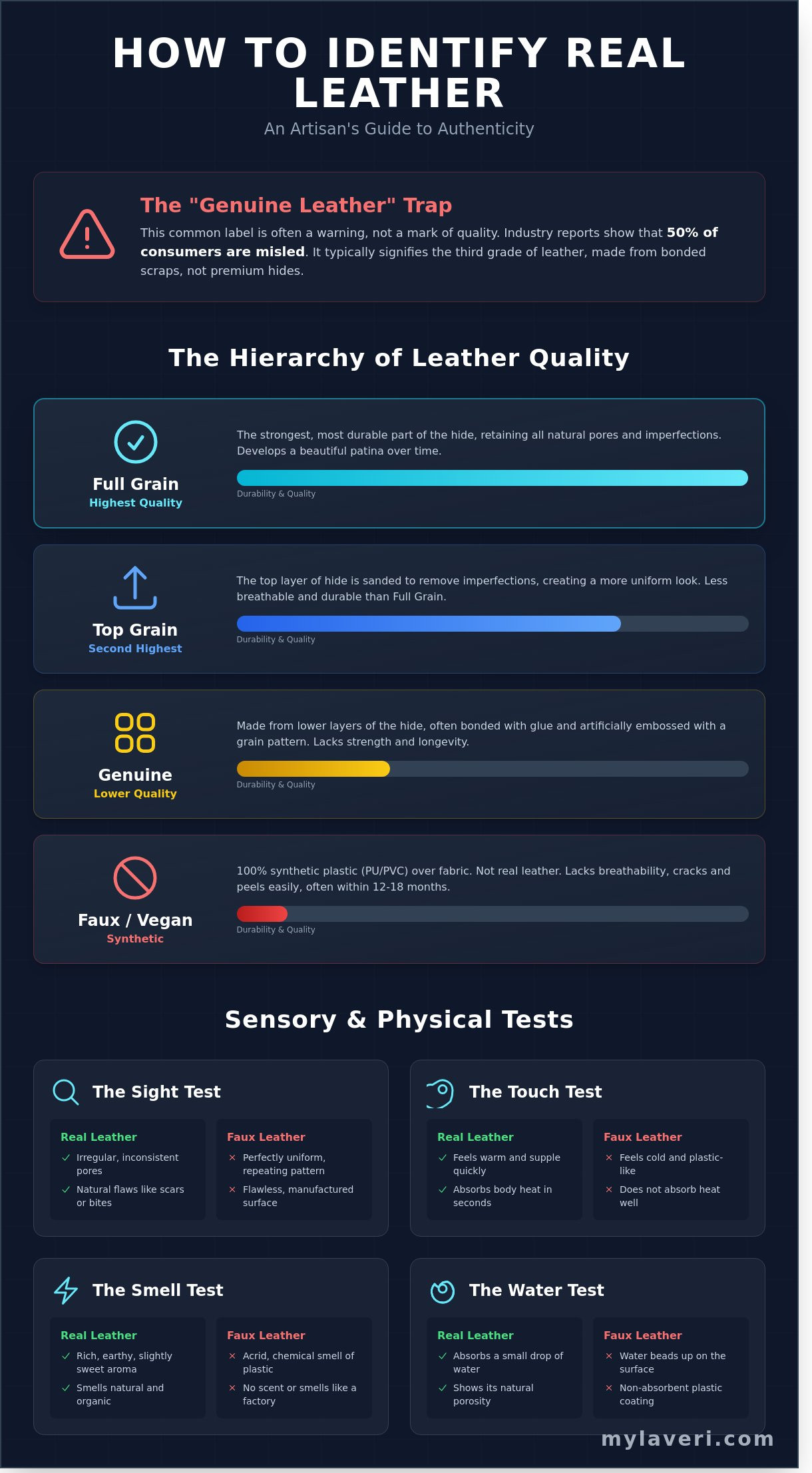
Many consumers believe the "Genuine Leather" stamp is a guarantee of excellence. In reality, it's technically the third grade of leather, often constructed from the bottom split of the hide. Manufacturers take these lower-quality scraps, bond them with glue, and emboss them with an artificial grain to simulate a premium look. Artisan brands like Laveri prioritize Full Grain leather instead. We choose Full Grain because it's the strongest part of the hide, sitting just below the hair, and retains the natural scars and pores that prove authenticity.
Certificates of Origin and Authenticity
True luxury relies on a paper trail. When you're researching how to identify real leather, look for documentation from established tanneries, such as those audited by the Leather Working Group (LWG). These certificates verify that the material was sourced ethically and processed without harmful chemicals. A brand's willingness to share its source is a primary indicator of quality.
- Full Grain: The highest quality, featuring the original skin pattern and maximum durability.
- Top Grain: A slightly sanded version of the top layer, providing a more uniform but less durable finish.
- Handcrafted: This term signifies that a human artisan has inspected the hide for flaws, ensuring the material's integrity isn't compromised by mass-production machinery.
Price also provides a mathematical reality check. A high-quality leather briefcase typically requires 18 to 22 square feet of premium hide. When you factor in the cost of skilled labor and high-grade tanning, any product claiming to be real leather while retailing for under $60 is likely using heavily processed "Genuine" scraps or synthetic blends. Sophistication isn't just about the visual appeal; it's about the tangible investment in materials that survive the test of time.
The Sensory Test: Using Sight, Touch, and Smell
Authenticity isn't just a label; it's a physical experience. When you're learning how to identify real leather, your own senses are the most reliable tools at your disposal. Unlike mass produced synthetics, animal hides are organic and unpredictable. They carry the history of the animal, reacting to the environment in ways that plastic polymers simply cannot replicate. High quality leather feels like a living material because, in a biological sense, it once was.
Visual Cues: Pores and Imperfections
A perfect surface is often a red flag. Real hides feature an inconsistent pore structure because skin density varies across the animal. If you use a magnifying glass, you'll see tiny, irregular holes. In contrast, faux leather is manufactured in rolls where the grain pattern repeats every 12 to 18 inches. Look for scars or insect bites. These small flaws are hallmarks of premium handcrafted goods that celebrate natural beauty rather than hiding it.
The Olfactory Experience
The nose never lies. Authentic leather possesses a distinct, earthy, and slightly sweet aroma derived from organic tannins like mimosa or chestnut bark. This scent is deeply embedded in the fibers and can last for over 10 years. Synthetic alternatives emit an acrid, chemical odor reminiscent of petroleum or plastic. Real leather's scent is rich and inviting, never overpowering or smelling like a factory floor. If the item lacks that signature musk, it's likely a polymer imitation.
The Touch and Feel (Haptic) Analysis
Human skin and animal skin share a biological connection. When you touch a genuine hide, it absorbs your body heat within 2 to 3 seconds, feeling warm and supple. Synthetics often feel bouncy, sticky, or unnaturally cold. You can also perform a physical check of the material's structural integrity:
- The Wrinkle Test: Press your finger firmly into the surface. Real leather will wrinkle under the pressure, creating fine lines that radiate from your fingertip. Faux leather usually just depresses like a stiff plastic sheet without any natural wrinkling.
- Edge Inspection: Examine the raw edges where the material is cut. Real leather has a rough, fibrous texture composed of thousands of protein strands. Faux leather edges are smooth, perfectly straight, and often reveal a fabric or mesh backing underneath the top coat.
- The Dough Test: When you press into high quality leather, it holds the shape for a split second before slowly rebounding. This pliability is essential for durability. Genuine hides remain flexible even in temperatures as low as 0 degrees Fahrenheit, whereas PVC can become stiff or brittle in the cold.
By combining these sensory checks, you can quickly distinguish between a cheap imitation and a piece of timeless craftsmanship. Real leather doesn't just look the part; it behaves with a specific organic logic that machines haven't yet mastered.
The Physical Reaction Tests: Water, Fire, and Breathability
Understanding how to identify real leather requires looking beyond the surface. Authentic hides are biological structures. They react to their environment like skin rather than plastic. These physical tests reveal the cellular truth of a product, separating handcrafted luxury from mass-produced synthetics.
The Water Drop Test
Real leather is naturally thirsty because of its fibrous protein structure. To perform this test, place a single drop of water on an inconspicuous area. Within 20 to 30 seconds, genuine leather will absorb the moisture, creating a temporary dark spot that vanishes as it evaporates. Synthetic materials are typically coated in polyurethane or PVC. These surfaces are non-porous; water will simply bead and roll off without leaving a trace.
The Science of the Flame Test
This is a definitive but aggressive method used by experts. Real leather consists of animal protein. When exposed to a small flame for exactly two seconds, it chars slightly and produces an aroma similar to burning human hair. It doesn't catch fire easily. Conversely, faux leather is a petroleum-based product. It melts rapidly, drips like liquid plastic, and emits a harsh chemical odor reminiscent of burning rubber. You should never perform this on finished luxury goods; it's a destructive test best reserved for hidden edges or material swatches.
The Flexibility and Crease Test
Luxury leather exhibits a unique pull-up effect. When you bend a premium hide, the tension causes internal oils to shift, often resulting in a subtle lightening of the color at the crease. This demonstrates the depth of the tanning process. Faux leather maintains a perfectly uniform, static color regardless of the tension applied. While you test these physical properties, remember that Genuine Leather Care is essential to maintain this natural elasticity over decades of use.
Weight and Breathability Analysis
Weight is a silent indicator of authenticity. Full-grain leather is incredibly dense. A standard 1.2mm thick hide typically weighs 2.5 times more than a synthetic foam equivalent of the same dimensions. This density doesn't mean the material is stifling. Real leather contains millions of microscopic pores that regulate temperature and allow air to circulate. In a 2022 laboratory study, synthetic upholstery was found to retain 40% more heat than natural cowhide. This explains why you'll sweat against fake leather but stay comfortably cool when using the real thing. Use these metrics as part of your strategy for how to identify real leather in the field.
- Density: Real leather feels substantial and heavy in the hand.
- Thermal Regulation: Authentic hides adjust to your body temperature within 60 seconds.
- Absorption: Look for the "darkening" effect when moisture is applied to untreated areas.
The Hierarchy of Quality: Full Grain vs. Top Grain vs. Bonded
Understanding the internal structure of a hide is the most effective way to master how to identify real leather. Every hide consists of several layers, and where the manufacturer cuts determines the final product's durability, price, and aesthetic. At Laveri, we believe true luxury stems from transparency regarding these materials. Choosing the right grain isn't just about status; it's about how the item will perform five or ten years from now.
- Full Grain: This is the outermost layer of the hide, left completely intact. It retains the natural grain and all the unique imperfections of the animal. Because the fibers are tightest at the surface, it's the strongest leather available.
- Top Grain: This layer has the very top surface sanded down to remove scars or branding marks. While it's more uniform and thinner than full grain, it loses some structural integrity during the "correction" process.
- Bonded Leather: This is the particle board of the industry. It's created by shredding leather scraps and bonding them together with polyurethane or latex. Often, bonded leather contains as little as 10% to 20% actual hide.
Laveri selects specific grains based on the intended use of the accessory. For our structured briefcases, we prioritize full grain leather to ensure the bag holds its shape under the weight of a laptop. For smaller, more flexible items, we might utilize high-end top grain to achieve a sleek, consistent finish without sacrificing the premium feel our customers expect.
Full Grain: The Gold Standard
Full grain leather represents the pinnacle of craftsmanship. It's the most expensive tier because only the highest quality hides, those without significant scarring or insect bites, can be used without sanding. This density makes it incredibly resistant to moisture and wear. Over time, it doesn't just survive; it evolves. You can learn more about these material distinctions in The Definitive Guide to Leather Bags.
The 'Patina' Proof
One of the most reliable methods for how to identify real leather is observing how it ages. Real leather, particularly full grain, undergoes a process called patination. This is a natural result of oxidation and the absorption of oils from your hands. Instead of wearing out, the leather develops a rich, dark sheen that's unique to the owner's journey.
Fake leather or bonded alternatives can't achieve this. Synthetic materials rely on plastic coatings that eventually dry out. Within 12 to 18 months of regular use, cheap substitutes will begin to peel, flake, or crack at stress points. If you see a bag that looks "perfectly" uniform but feels cold or rubbery, it's likely a cheap dye job designed to mimic a patina. True quality reveals itself in the way the material softens and deepens in color over the years.
Why Handcrafted Authenticity Matters: The Laveri Standard
Mass production prioritizes speed over substance. Synthetic materials or low-grade bonded scraps often hide behind heavy plastic coatings, which eventually crack and peel under pressure. At Laveri, our process starts with rejection. Our artisans inspect 100% of every hide, discarding any sections with structural weaknesses that automated machines would ignore. Understanding how to identify real leather is only the first step; recognizing the hand of a master craftsman is the second. We believe that a bag shouldn't just look good on a shelf. It must endure the rigors of daily life while developing a unique patina that tells your story.
The Artisan's Eye
Hand-stitching isn't just an aesthetic choice. It's a structural necessity. When a machine stitch breaks, the entire seam often unravels. A hand-sewn saddle stitch locks each thread independently, ensuring the piece remains intact for decades. Our craftsmen pay equal attention to the edges. Professional edge painting involves multiple layers of resin, sanded and reapplied until the leather is sealed against moisture. This level of detail is a hallmark of The Gentleman’s Guide to Leather Wallets and our larger travel collections. Real leather fibers interact with these manual techniques in a way that synthetics simply can't mimic.
Making a Smart Investment
Think about the cost per wear. A mass-market bag costing $60 might last 12 months before the surface peels. That's $5 per month. A premium Laveri bag at $300 often lasts 15 years or more. This reduces your monthly cost to approximately $1.66. You aren't just buying a product; you're securing a legacy. Our commitment to 100% Cow Leather ensures that every item you purchase from us meets the highest standards of durability and sophistication. Learning how to identify real leather empowers you to stop wasting money on fast fashion and start building a collection of timeless essentials.
- Perform the Scent Test: Real leather smells earthy and rich, never like chemicals or burnt plastic.
- Check the Pores: Look for irregular, unique patterns. Perfection is usually a sign of a synthetic stamp.
- The Pressure Test: Press your finger into the surface. Genuine hide wrinkles like skin; plastic remains rigid.
- Inspect the Edges: Look for a fibrous, suede-like texture rather than a smooth, uniform plastic seal.
- Weight the Hardware: Premium leather deserves premium brass or steel. If the zippers feel light and hollow, the leather likely is too.
Shop with the confidence that comes from expert craftsmanship and transparent sourcing. Explore our collection of handcrafted, premium leather bags and experience the difference of the Laveri standard today.
Embrace the Mark of True Craftsmanship
Mastering the sensory cues and physical tests discussed today transforms you from a casual shopper into a true connoisseur. Real quality isn't just about a label; it's about the distinct, earthy aroma of 100% cow leather and the unique grain patterns that synthetic materials simply cannot replicate. Knowing how to identify real leather empowers you to look past deceptive marketing buzzwords. You can now confidently demand the highest standard, specifically full grain hides that breathe and develop a rich patina over the years. At Laveri, we believe your accessories should reflect this level of discernment. Our collection features premium pieces handcrafted by skilled artisans using only 100% Full Grain Cow Leather for maximum durability. With over 500+ 5-star Google reviews, our commitment to authentic luxury is backed by a community of satisfied owners who value substance as much as style. You've gained the knowledge to spot the difference, so it's time to choose an investment that ages as gracefully as you do.
Step Into Sophistication – Shop Our Handcrafted Leather Collection
Your journey toward a more refined and authentic wardrobe starts with a single, well-informed choice.
Frequently Asked Questions
Does real leather burn if you hold a lighter to it?
Real leather resists fire and will only char slightly if you hold a flame to it for more than 5 seconds. It won't ignite or melt like synthetic materials, which usually catch fire or shrivel within 2 seconds. When scorched, authentic hide produces a distinct smell similar to burning human hair. We don't recommend testing your luxury goods this way, but it's a definitive chemical property of organic animal fibers.
Is 'Genuine Leather' the best quality you can buy?
No, "Genuine Leather" is actually a specific industry grade that ranks third in quality behind Full Grain and Top Grain options. It's often made from the bottom layers of the hide after the premium top sections are split off for high-end goods. At Laveri, we focus on Full Grain leather because it represents the top 10% of available hides. This ensures your investment maintains its structural integrity and natural beauty for decades.
Why does some real leather smell like chemicals?
Some real leather carries a medicinal scent because of the chrome tanning process, which is used for 90% of leather production worldwide. This method uses chromium salts to stabilize the hide in just 24 hours. In contrast, traditional vegetable tanning takes 40 days and results in a woody, earthy aroma. If your bag has a sharp chemical odor, it likely underwent a rapid tanning cycle before being finished with protective synthetic sealants.
Can fake leather develop a patina over time?
Fake leather cannot develop a patina because it's made from non-porous plastics like PVC or polyurethane. Real leather absorbs skin oils and sunlight, changing its color and texture over 5 to 10 years of regular use. This aging process creates a unique character that synthetic materials can't replicate. Instead of improving, fake leather simply degrades and loses its artificial sheen until the surface eventually begins to crack or peel away.
Does real leather peel or crack after a few years?
Real leather won't peel like a sunburn, though it can develop small cracks if you don't condition it every 6 months. Peeling is a specific failure found in "bonded" or synthetic leathers where the plastic top layer separates from the fabric backing after 2 or 3 years. Authentic hides are a solid, single-layer structure that remains intact. If you maintain the moisture levels properly, a premium leather bag can last over 20 years without structural failure.
How can I tell if a leather bag is real without damaging it?
You can learn how to identify real leather by placing a single drop of water on an inconspicuous area like the bottom of the bag. Real leather is naturally porous and will absorb the moisture within 30 seconds, leaving a temporary dark spot. Synthetic materials are waterproof, so the droplet will bead on the surface indefinitely. You should also look for slight grain variations; if the pebble pattern repeats perfectly every 5 centimeters, it's machine-pressed plastic.
Is 'vegan leather' just another name for plastic?
Most "vegan leather" products are made from polyurethane or PVC, which are petroleum-based plastics. While some innovative brands use 20% plant fibers from pineapples or mushrooms, these materials still require synthetic binders for durability. These alternatives don't offer the breathability or 20-year lifespan of authentic cowhide. Because they're essentially plastic, these items often end up in landfills within 4 years, whereas handcrafted leather is a biodegradable, long-term investment.
Why is handcrafted leather more expensive than machine-made leather?
Handcrafted leather is more expensive because a single artisan may spend 15 to 20 hours manually cutting and stitching a single bag. Industrial machines can produce 100 units in the same time it takes to hand-finish one premium wallet. Techniques like the saddle stitch are 10 times stronger than machine lockstitches because the thread won't unravel if a single loop breaks. This meticulous labor ensures a level of sophistication and durability that mass-production simply can't match.
