

Personalized Leather Journal Cover: The 2026 Buying Guide to Timeless Craftsmanship
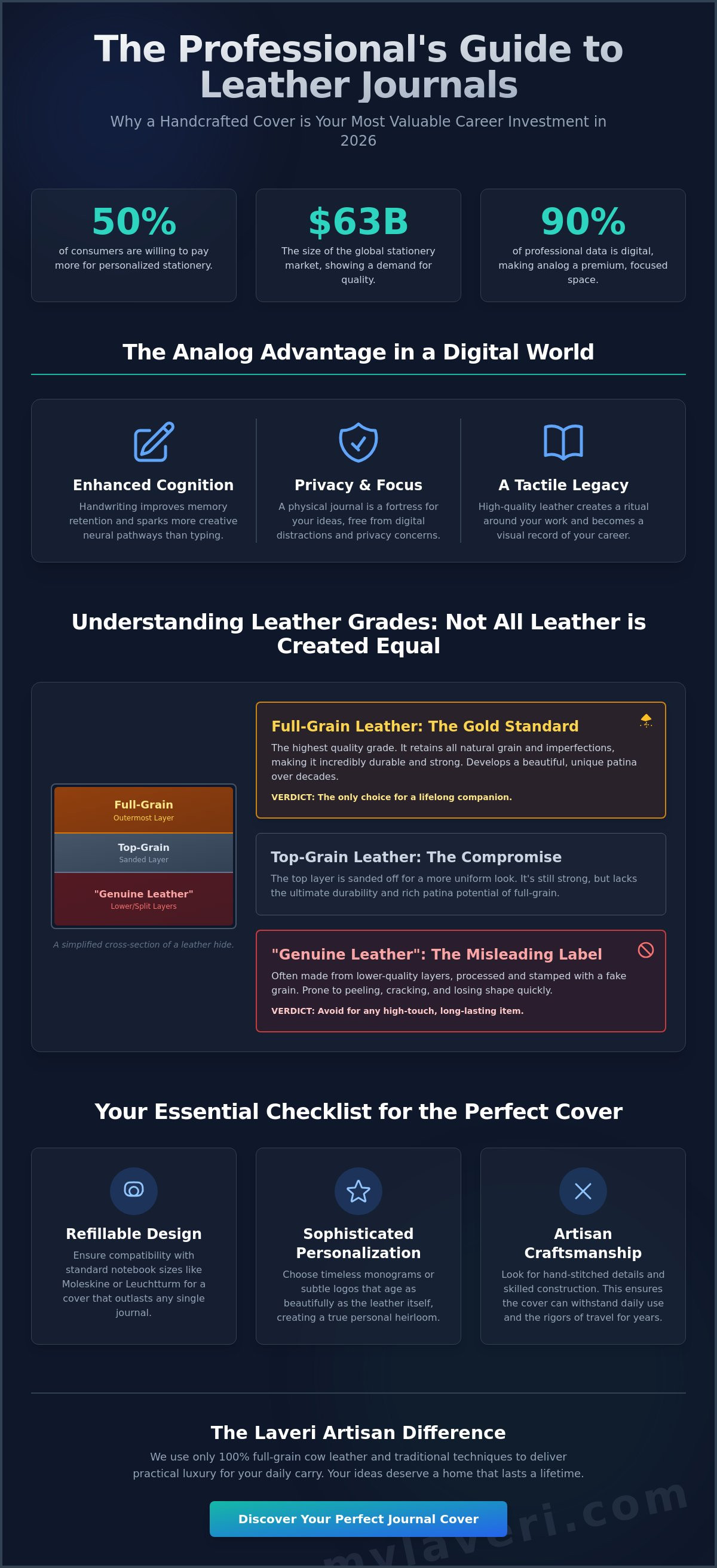
Did you know that 50% of global consumers are now willing to pay a premium for customized stationery that tells a personal story? In 2026, a personalized leather journal cover is no longer just a protective sleeve. It is a tactile legacy piece that signals professional sophistication and creative intent. You likely understand that your ideas deserve a permanent home, yet it's frustrating when "genuine" leather covers peel or fail to fit your favorite Moleskine or Leuchtturm refills.
We agree that a journal should be a lifelong companion that ages as gracefully as your own wisdom. This guide promises to help you navigate the $63.29 billion stationery market to find a handcrafted, full-grain cover that fits perfectly and features personalization that won't fade. We'll explore the technical differences in leather grades, the importance of refillable designs, and how to choose a piece that reflects your personal journey through 2026 and beyond.
Key Takeaways
- Learn why a handcrafted cover serves as a vital shield for your intellectual property in an increasingly digital professional world.
- Identify high-quality full-grain leather to avoid misleading "genuine leather" labels that often peel or crack over time.
- Compare refillable and fixed designs to ensure your cover fits standard Moleskine or Leuchtturm notebook sizes perfectly.
- Discover how to choose a personalized leather journal cover with sophisticated monograms that age beautifully alongside the material.
- Understand the Laveri artisan difference, where 100% cow leather and skilled craftsmanship deliver practical luxury for your daily carry.
Why a Personalized Leather Journal Cover is a Modern Professional Essential
With 90% of professional data now created and stored digitally, the analog journal has evolved from a simple notebook into a fortress for your most valuable intellectual property. A personalized leather journal cover acts as a durable, refillable shield for your strategic thoughts. It protects your ideas from the rigors of daily travel while providing a sense of permanence that a glass screen simply cannot replicate. It's a smart, stylish investment for anyone who views their writing as a core part of their professional legacy.
High-quality leather doesn't just survive use; it matures with it. Every minor scratch and the natural oils from your hands contribute to a unique patina, creating a visual record of your hard work and career milestones. This is why we prioritize 100% cow leather. It improves with daily handling, turning a functional tool into a sophisticated companion that looks more distinguished in 2026 than the day you first held it.
The Resurgence of the Analog Notebook
Top executives and creative directors are increasingly stepping away from plastic devices during high-level strategy sessions. Research into cognitive function suggests that handwriting improves memory retention and sparks more creative neural pathways than typing on a keyboard. The tactile satisfaction of full-grain leather creates a necessary ritual around reflection and planning. This focus on quality over quantity aligns perfectly with our minimalist bag philosophy, where every item in your daily carry must serve a distinct, premium purpose.
Writing by hand also offers a level of privacy and focus that digital apps can't match. Modern artisans often draw inspiration from traditional bookbinding techniques to ensure these covers provide the same structural integrity as history's most famous manuscripts. When you wrap your thoughts in handcrafted leather, you're choosing a medium that has successfully preserved human knowledge for centuries.
The Emotional ROI of Personalization
True personalization goes far beyond a simple name tag. It's about identity and the creation of a future heirloom. When you add a monogram or a custom logo, you transform a high-quality commodity into a piece of your own story. This level of detail is essential for establishing a professional personal brand during meetings and high-stakes networking events. It signals to others that you value your ideas enough to house them in a vessel of exceptional craftsmanship.
Because of this lasting value, these journals consistently rank as a top-tier choice for luxury gifts for men. You aren't just giving a stationery item; you're providing a tool for their future achievements. A monogrammed cover becomes a constant companion, aging alongside the user and reflecting their professional journey with every passing year.
Choosing Your Canvas: Leather Grades and Size Compatibility
Not all leather is created equal. For a personalized leather journal cover, the grade of material determines if the item lasts three years or thirty. Full-grain leather is the gold standard because it hasn't been sanded or buffed to remove natural imperfections. Full-grain leather is the outermost layer of the hide, retaining all natural grain and durability. This raw strength allows the cover to withstand thousands of opening and closing cycles without the fibers breaking down or cracking at the spine.
Many commercial brands use "Genuine Leather," which is often a misleading marketing term. In the hierarchy of materials, genuine leather typically refers to the lower layers of the hide that have been processed and embossed with a fake grain. While it looks fine on a shelf, high-frequency items like journal covers quickly show wear, peeling or losing their shape within months. Top-grain leather is a middle ground, offering a more uniform look by removing the top layer, but it lacks the long-term resilience and rich patina potential of full-grain options.
Understanding Leather Quality for High-Touch Items
A journal cover is a high-touch object. You handle it every day, often multiple times. This constant friction and flexing require a material that remains supple yet strong. Vegetable tanning is a traditional process that uses natural tannins from tree bark and plants. It results in a leather that not only smells rich but also develops a unique character over time. This process ensures the leather remains breathable and flexible, preventing it from becoming brittle in dry environments. Choosing a premium leather accessory that utilizes these artisan methods ensures your investment stays functional for decades.
Size Guide: Finding the Perfect Fit
Precision is non-negotiable for a premium feel. An A5 cover (5.8 x 8.3 inches) is the professional standard, accommodating the most popular executive notebooks. For those who prioritize portability, Pocket or A6 sizes are ideal for quick notes on the move. If you use specialized inserts, keep these compatibility notes in mind:
- Moleskine Large (5 x 8.25 in): Fits most standard A5 covers but always check for spine depth.
- Leuchtturm1917 A5 (5.75 x 8.25 in): Slightly wider than Moleskine, requiring a more generous cut to prevent the edges from curling.
- Rhodia Webnotebook (5.5 x 8.25 in): Known for thick, high-gsm paper, which adds bulk to the spine and requires a flexible cover.
Measure the height, width, and spine thickness of your notebook while it's closed. A perfect personalized leather journal cover should have a 2-3mm margin to allow for the natural "creep" of the pages when the book is opened flat. This small allowance ensures your writing experience remains fluid and unencumbered, regardless of how many pages you've filled.
Refillable vs. Fixed Covers: Finding the Right Fit for Your Workflow
A fixed-bound journal offers a certain classic charm, but it creates a dilemma once the last page is turned. You're forced to retire both the paper and the cover, often leaving a beautiful piece of leather to sit on a shelf. In contrast, a refillable personalized leather journal cover represents a more sustainable, long-term commitment. With the global personalized stationery market projected to reach $21.2 billion in 2026, more professionals are choosing systems that allow them to archive their thoughts while retaining their seasoned leather exterior.
The cost-effectiveness of this approach is undeniable. While the initial investment in premium full-grain leather is higher, the ability to swap in standard refills like Moleskine or Leuchtturm1917 for years reduces your long-term spend. It also allows for a "multi-insert" workflow, popularized by the "Midori" or Traveler’s style systems. This setup lets you carry a planner, a sketchbook, and a lined notebook all within a single, sophisticated shield. It's a practical luxury that adapts to your changing project needs throughout the year.
The Case for Refillable Systems
Professionals who manage multiple workstreams often prefer refillable covers for their sheer versatility. You don't have to commit to one paper type for the life of the leather. You can switch from dotted grids for technical diagrams to blank pages for creative sketching in seconds. This flexibility supports a minimalist lifestyle centered on the "buy once, buy well" philosophy. By 2026, 45% of consumers have shifted their preference toward these customized, durable items that reduce environmental impact while maintaining a high-end aesthetic.
Comparing Closure Styles: Elastic, Snap, and Wrap
The way your journal closes affects both its security and your writing comfort. You should choose a style that complements your specific workflow:
- Leather Wrap: Offers maximum protection for the paper edges and a timeless, rugged look. It doesn't use hardware, which means there's no metal to press against your hand while you write.
- Elastic Bands: These are the choice for quick-access users. They're utilitarian and keep the profile slim, though the elastic may eventually need replacement after years of heavy use.
- Snap Studs: Provide a satisfying, secure click. While they add a touch of modern hardware, ensure the snap's underside is lined so it doesn't leave an indentation on your notebook's first page.
The aesthetic impact of these choices is significant. A clean, bifold design without visible closures offers the most minimalist professional look. However, if you're a traveler who tosses your personalized leather journal cover into a crowded bag, a wrap or snap closure is a necessary practical addition.
The Art of Personalization: Monograms, Logos, and Customization Styles
Personalization is the final touch that transforms a premium accessory into a lifelong companion. While 50% of shoppers in 2026 choose customization to mark personal milestones, the method you select determines how long that mark remains legible. A personalized leather journal cover should reflect your professional identity without compromising the material's integrity. Choosing the right technique is a balance between aesthetic preference and the practical reality of daily carry.
Corporate gifting has also seen a shift toward this level of detail. High-level executives often prefer subtle company logos over loud branding. A debossed logo on a handcrafted cover serves as a constant reminder of a partnership or a career achievement. It's a sophisticated way to build a personal brand that feels earned rather than bought, especially when paired with 100% cow leather that is built to last.
Debossing vs. Engraving: Which Lasts Longer?
Blind debossing involves using a metal die to press your initials directly into the leather using heat and high pressure. This technique is favored by artisans because it doesn't introduce external inks or foils that can flake away. Debossing creates a permanent physical indentation that becomes more pronounced as the leather patinas. In contrast, laser engraving burns away the top fibers of the leather. While this allows for incredible detail in complex logos, it can sometimes feel slightly rough to the touch compared to the smooth, pressed finish of debossing. Foil stamping offers a brilliant metallic look, but it's prone to wearing off if the journal is frequently slid in and out of a laptop bag.
Strategic Placement and Font Choice
When it comes to layout, the "less is more" rule usually applies to luxury goods. Placing a monogram in the bottom right corner is the standard for professional appeal. It's visible but doesn't distract from the natural beauty of the full-grain hide. If you prefer a more private touch, consider a secret "inner cover" personalization that's only visible when the journal is open. This is a popular choice for those using a personalized leather journal cover for private reflection or sensitive project planning.
Your choice of font should complement the leather's texture and your own personality. Serif fonts like Garamond or Baskerville evoke a sense of tradition and academic rigor. Sans-serif fonts like Montserrat provide a clean, modern edge that fits well in tech-forward environments. Whatever your style, ensure the scale is appropriate; a 10mm to 12mm height is typically the sweet spot for legibility and elegance. To see how these styles look on premium materials, you can explore our handcrafted leather collection today.
The Laveri Leather Store Artisan Difference: Handcrafted Heritage for Your Daily Carry
At Laveri Leather Store, we believe that a personalized leather journal cover is an extension of your professional identity. Since 1990, we've remained committed to the art of fine leatherwork, operating our own in-house tannery to ensure total quality control. This vertical integration allows Laveri Leather Store to select only the finest 100% cow leather for our products. While other brands might outsource production to cut costs, our UAE-based roots and skilled artisans ensure every piece meets the highest standards of timeless craftsmanship. It's about delivering practical luxury that handles the rigors of your daily commute while maintaining an air of effortless sophistication.
Our commitment to quality extends far beyond the surface. We understand that your journal is a high-frequency tool, which is why Laveri Leather Store focuses on "Practical Luxury." This means our designs aren't just for show; they're built to be used. Whether you're in a boardroom in Dubai or a studio in New York, our international delivery ensures that world-class leatherwork is always within reach. By bridging the gap between high-end aesthetics and everyday functionality, Laveri Leather Store provides a product that doesn't just sit on a shelf but actively supports your creative and professional workflow.
Handcrafted Quality You Can Feel
The durability of a journal cover often comes down to the details that the naked eye might miss. The artisans at Laveri Leather Store prioritize hand-stitched edges over machine-stitched alternatives. Hand-stitching creates a "saddle stitch" that won't unravel even if a single thread breaks, unlike the lock-stitch used by mass-production machines. We also select specific sections of the hide that offer the perfect "flex" for a journal spine, ensuring the leather doesn't buckle or lose its shape over time. This meticulous approach gives you the peace of mind that comes with preserving luxury investments for the long haul.
A Complete Professional Aesthetic
A truly sophisticated carry is about cohesion. Your journal shouldn't be an outlier in your bag; it should complement your entire ensemble. Many of our clients choose to match their journal covers with pieces from the wider Laveri leather bag collection. Our covers are designed with specific dimensions to fit seamlessly into the dedicated compartments of a premium laptop bag, ensuring you stay organized without sacrificing style. When your wallet, belt, and personalized leather journal cover all share the same rich grain and handcrafted finish, you project an image of organized, meticulous success.
Ready to invest in a piece of your own professional legacy? Explore the Laveri Leather Journal Collection and discover the difference that genuine artisan skill makes to your daily carry.
Secure Your Professional Legacy
Your ideas deserve a home that reflects the weight of your ambitions. By choosing a personalized leather journal cover, you aren't just buying a stationery accessory; you're investing in a tactile record of your career. We've explored why full-grain leather is the only choice for durability and how refillable systems provide a sustainable solution for your evolving workflow. Selecting a debossed monogram ensures your journal remains a sophisticated staple as it ages, turning a simple notebook into a cherished heirloom.
Laveri Leather Store combines this modern need for customization with our heritage of timeless craftsmanship. Every piece is handcrafted from premium hides and is highly rated by global professionals who value substance alongside style. With reliable international delivery from our workshop, your journey toward a more organized and elegant carry is just a few clicks away. Don't settle for mass-produced alternatives that peel or crack. It's time to carry a piece that grows more beautiful with every page you fill.
Shop Handcrafted Personalized Leather Journal Covers
Frequently Asked Questions
What is the best leather for a journal cover?
Full-grain genuine leather is the superior material for a journal cover because it retains the hide's strongest fibers and natural grain. This premium grade ensures your cover won't crack or peel under the stress of daily folding. Unlike lower-grade leathers that use artificial coatings, full-grain develops a rich patina that reflects your personal usage over years of handling.
Will a personalized leather journal cover fit my Moleskine notebook?
Most covers are specifically engineered to fit standard sizes like the Moleskine Large, which measures 5 by 8.25 inches. A high-quality personalized leather journal cover should provide a snug fit while allowing enough room for the spine to expand as you fill the pages. Always check the internal sleeve dimensions to ensure your specific notebook brand slides in smoothly without bending the corners.
Does the personalization wear off over time?
Blind debossing is a permanent customization method that won't wear off. Because the heat and pressure create a physical indentation in the fibers, the monogram becomes part of the leather itself. While metallic foils can eventually fade with heavy friction, a deep-pressed debossing actually becomes more distinct as the leather patinas and softens over decades of use.
How do I clean and maintain my leather journal cover?
You should clean your cover with a soft, slightly damp cloth to remove surface dust and oils. For long-term maintenance, apply a premium leather conditioner every six months to keep the fibers supple and prevent drying. Avoid using harsh chemicals or excessive water, as these can strip the natural oils that give handcrafted leather its unique texture and protective qualities.
Can I add a company logo to a leather journal cover for corporate gifts?
You can absolutely add a company logo to your personalized leather journal cover for high-end corporate gifting. Modern artisans use custom-made metal dies to ensure logos are rendered with sharp, professional precision. This is a popular choice for the 45% of businesses that now prefer to provide executives with gifts that carry lasting brand value and professional sophistication.
What is the difference between a refillable and a non-refillable leather journal?
A refillable leather journal features internal sleeves that allow you to replace the paper insert once it's full. A non-refillable or fixed journal has the pages permanently bound to the leather. Professionals typically prefer refillable options because they can archive their completed notes while keeping the seasoned, high-quality leather exterior for their next project.
How long does a handcrafted leather journal cover typically last?
A handcrafted leather journal cover typically lasts 25 to 30 years with basic care. Because we use 100% cow leather and reinforced stitching, these covers are designed to outlast the notebooks they protect. The durability of full-grain hide means the structural integrity remains intact even after decades of being carried in bags and opened daily.
Are leather journal covers water-resistant?
Leather is naturally water-repellent but it isn't waterproof. While a few drops of rain won't damage premium full-grain leather, you should wipe away moisture immediately to prevent staining. If the cover gets soaked, let it air dry naturally away from direct heat sources to ensure the leather doesn't become brittle or lose its shape.
