

What to Look for in a Quality Leather Belt: The 2026 Connoisseur’s Guide
That "genuine leather" stamp on your accessory isn't a mark of excellence; it's often a warning that your belt will crack and peel before the season ends. You've likely felt the frustration of a buckle losing its luster or a hide splitting after only six months of daily use. It's difficult to distinguish between overpriced marketing and true artisanal skill when every brand claims to be premium. Understanding exactly what to look for in a quality leather belt transforms a routine purchase into a sophisticated, lifetime investment that develops a rich patina over time.
We agree that your wardrobe deserves better than mass-produced compromises that fail to last. This guide promises to help you master the art of identifying premium craftsmanship and high-grade hides to ensure your next purchase is a permanent staple. We will preview the essential 2026 standards, including why you should demand LWG-certified materials and how to spot hardware that meets the strict 500 ppm lead limits of EU REACH regulations. From ISO-tested tensile strength of 200 Newtons to the return of statement wide belts, you'll learn how to choose a piece that balances modern trends with timeless durability.
Key Takeaways
- Learn why handcrafted accessories provide a psychological edge in professional settings and support a sustainable, "Buy It For Life" philosophy.
- Understand the structural superiority of full-grain leather to ensure your investment develops a natural patina without sacrificing structural integrity.
- Identify the technical markers of artisanal skill, such as indestructible saddle stitching and burnished edges, when determining what to look for in a quality leather belt.
- Master two practical on-the-spot tests—the Flex and the Smell test—to instantly distinguish vegetable-tanned hides from chemically treated alternatives.
- Discover how combining 100% cow leather with traditional craftsmanship creates a versatile piece that balances modern sophistication with everyday durability.
Beyond Utility: Why Investing in a Quality Leather Belt Matters
A belt is often the most underrated element of a man's wardrobe. While its primary function is utility, a premium, handcrafted belt serves as a silent ambassador of your personal standards. In professional environments, the subtle gleam of high-grade hide and a well-finished buckle signal an attention to detail that commands respect. Choosing an accessory that balances structural integrity with artisanal finishing is a power move. It bridges the gap between a sharp navy suit and weekend chinos with effortless grace. When you understand what to look for in a quality leather belt, you stop buying disposable fashion and start building a legacy wardrobe.
The distinction between a mass-produced item and a luxury piece lies in how it ages. A low-quality belt "wears out," meaning the surface peels and the holes stretch until the item is unusable. Conversely, a premium full-grain belt "wears in." It develops a rich patina, a unique sheen that reflects your lifestyle and only improves with time. In 2026, the "Buy It For Life" philosophy has shifted from a niche trend to a standard for the sophisticated consumer who values sustainability over temporary trends.
The Fast-Fashion Trap: Why Cheap Belts Fail
Most department store options rely on "genuine leather," which is a deceptive marketing term for the lowest grade of usable hide. These products often consist of bonded leather scraps held together by synthetic glues and plastic fillers. They lack the natural fibers needed to withstand daily tension. This construction leads to inevitable cracking within six months of use. Beyond the poor performance, these disposable accessories carry a heavy environmental cost. They contribute to a cycle of waste that high-end, LWG-certified tanneries work hard to avoid. Understanding Leather Grades is the first step in escaping this trap and choosing materials that respect both the wearer and the planet.
The Luxury Investment: Understanding Cost-Per-Wear
Sophisticated shoppers prioritize the cost-per-wear ratio. A belt designed to last 20 to 30 years provides significantly better value than five cheap alternatives that fail annually. A single high-quality belt elevates every outfit it touches, making even basic denim look intentional and refined. To maintain this consistent aesthetic of excellence across your entire look, you might also explore The Definitive Guide to Leather Bags. Investing in 100% cow leather ensures your accessories remain as durable as they are beautiful, allowing you to move through 2026 with the confidence of a true connoisseur.
Decoding the Hide: Understanding Leather Grades and Tanning
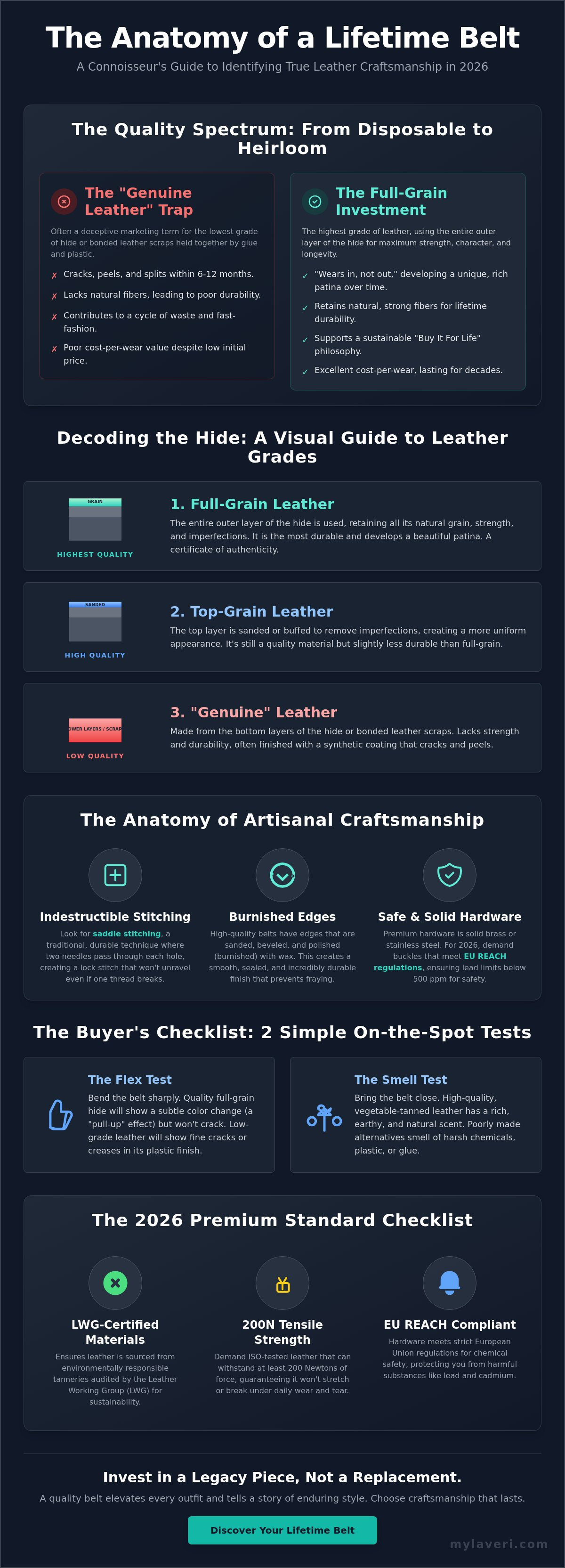
Understanding the hierarchy of hides is essential when deciding what to look for in a quality leather belt. Not all leather is created equal; the industry separates materials into distinct grades based on which part of the skin is used and how it's processed. At the top of this hierarchy sits full-grain leather. This material uses the entire outer layer of the hide, including the natural grain that contains the strongest fibers. Because it isn't sanded or buffed to remove imperfections, it retains its maximum structural integrity and breathability. For a connoisseur, the presence of small scars or pores isn't a flaw but a certificate of authenticity.
Below full-grain lies top-grain leather. While still a premium material, the very top layer has been sanded down to remove natural marks. This process creates a more uniform, "perfect" appearance that often suits formal dress belts. However, this aesthetic comes at a cost. Sanding removes the toughest fibers, meaning it won't be quite as durable as its full-grain counterpart. When considering what to look for in a quality leather belt, you must decide if you value the pristine look of top-grain or the rugged endurance of full-grain. If you see a belt that looks too perfect to be real, it's likely top-grain or, worse, "genuine leather." Despite the name, genuine leather usually consists of the bottom layers of the hide or bonded scraps. It lacks the strength to withstand daily wear, often cracking within months.
Full-Grain vs. Top-Grain: Which Suits You?
Full-grain is the definitive choice for those who appreciate character. It often features a "pull-up" effect, where the leather lightens in color when stretched or folded, indicating a high concentration of natural oils and waxes. This ensures the belt remains supple and resistant to the 20,000-cycle flex tests required by ISO 5402 standards. Top-grain may be preferred for high-fashion pieces where a consistent, embossed texture is required, but it lacks the lifetime longevity of a 4-5 mm thick full-grain strap.
The Magic of Vegetable Tanning
The method used to preserve the hide is just as critical as the grade itself. Most mass-market belts use chrome tanning, a chemical-heavy process that takes only days. While efficient, it can leave behind toxic residues if not strictly controlled to the 3 mg/kg limit for Chromium VI. Artisans favor vegetable tanning, an ancient technique using tannins found in tree bark and leaves. This organic process can take several months, but it results in a sturdy, earthy-smelling leather that is famous for developing a deep patina. The EPA provides detailed technical insights into these Tanning and Finishing Processes, highlighting the complexity of modern leather production. To ensure your vegetable-tanned piece remains in peak condition, following a dedicated Genuine Leather Care routine is vital. Choosing a handcrafted belt from Laveri ensures you are receiving a hide that has been treated with this level of meticulous care.
The Anatomy of Craftsmanship: Stitching, Edges, and Hardware
The hide is only half the story. Once you've identified a premium full-grain material, the focus shifts to how that material is bound and finished. Structural integrity is the most critical factor when determining what to look for in a quality leather belt. While most mass-produced options use machine lock-stitching, true artisanal pieces utilize saddle stitching. This technique involves two needles passing through the same hole from opposite directions. If a machine stitch breaks, the entire seam can unravel like a zipper. A saddle stitch, however, creates an independent knot at every puncture. It's nearly indestructible and ensures the belt maintains its ISO 3376 tensile strength, easily withstanding the industry standard of 200 Newtons of force.
Construction also varies based on the belt's purpose. Casual belts are typically "single-piece" straps, relying on the natural thickness of a 4-5 mm hide for durability. Dress belts often feature a lining. This involves bonding two thinner layers of leather together, sometimes with a structural filler in between, to create a refined, tapered look. A quality lined belt will always use leather for both the face and the lining. Synthetic linings are a red flag; they don't breathe and will eventually cause the leather to sweat and rot from the inside out.
The Art of the Burnished Edge
The edge of a belt is where most failures begin. Low-quality manufacturers use "edge paint" to hide raw cuts. This thick, rubbery coating looks perfect on the shelf but inevitably cracks and peels as the leather flexes. In contrast, a master artisan uses burnishing. This process involves using friction and natural waxes to heat the leather fibers until they fuse together, creating a smooth, glassy seal. A burnished edge won't peel because it's part of the leather itself. You can identify this by looking for a slight transparency where the natural grain of the hide is still visible beneath the finish.
Hardware: The Weight of Quality
Buckles are the most frequent point of failure in modern accessories. Many "luxury" brands use zinc alloy buckles with a thin metallic plating that chips off within months. When assessing what to look for in a quality leather belt, always demand solid brass or 316L stainless steel. These materials are corrosion-resistant and won't lose their finish because the color is consistent throughout the metal. Perform the "clink test" by tapping the buckle with a ring or coin. Hollow zinc produces a high-pitched, tinny sound, while solid brass offers a satisfying, heavy thud. This commitment to metal quality mirrors the standards found in Laveri’s handcrafted leather wallets for men, where every component is chosen for its ability to meet the strict 500 ppm lead limits of EU REACH regulations.
The Buyer’s Checklist: 5 Practical Tests for Quality
Armed with technical knowledge, you can now apply physical tests to verify a brand's claims. When determining what to look for in a quality leather belt, your first check should always be the thickness. A premium casual belt should measure between 3.5mm and 4mm. Anything thinner likely lacks the structural integrity to prevent stretching, while anything thicker may feel cumbersome and stiff. Next, inspect the adjustment holes. A quality artisan finishes these punches with heat or burnishing to prevent the leather from fraying. If the inside of the hole looks raw, fuzzy, or shows a different color than the surface, the belt is likely a lower-grade hide with a painted top coat.
The method of buckle attachment also reveals the manufacturer's intent. Permanent stitching is the most secure and traditional method, but it doesn't allow you to swap buckles. High-end versatile belts often use Chicago screws. These allow for buckle changes while maintaining a flush, premium look. Avoid snap attachments; they are a hallmark of mass production and often fail under the daily tension of a 200 Newton load. These small details are the easiest way to identify a piece that will actually last for the promised 20 to 30 years.
Conducting the Flex and Grain Test
Pick up the belt and bend it into a sharp U-shape with the grain side facing out. A quality full-grain belt will show natural "fat wrinkles" or a slight change in color as the oils move through the fibers. However, the surface finish should never crack or peel. If the leather feels like plastic or shows spiderweb-like fractures in the finish, put it back. A premium strap should feel stiff but supple during your first encounter. It won't be as floppy as a fabric belt, but it shouldn't feel like a piece of dry wood either.
Inspecting the Underside (The Flesh Side)
Flip the belt over to examine the "flesh side." On a solid, single-piece strap, this side should be smooth or have a light, consistent "nappy" texture. It should never feel like loose, long-haired suede or look like a fuzzy mess. If the underside looks suspiciously like a different material, you've likely found a synthetic lining hidden under a thin leather veneer. This construction is common in "genuine leather" products that fail within six months. Finally, trust your nose. A vegetable-tanned belt will have a rich, earthy, and sweet aroma. If it smells like gasoline or harsh chemicals, it was likely processed in a low-standard tannery that ignores modern chemical restrictions.
Ready to invest in a piece that passes every test? Browse the Laveri collection to find handcrafted belts designed for a lifetime of sophistication.
Elevating Your Wardrobe: The Laveri Approach to Timeless Belts
At Laveri, we believe an accessory should be a silent partner in your success. We've spent this guide detailing what to look for in a quality leather belt, but the true test is how a brand executes those technical standards. Our philosophy centers on "Practical Luxury." We don't just follow the rules of craftsmanship; we obsess over them. By sourcing only 100% cow leather, we ensure every strap possesses the fiber density required to survive decades of use. While other brands chase fleeting aesthetics, we focus on the structural integrity that defines a lifetime investment.
This commitment to durability and elegance makes our collection a premier choice for luxury gifts for men. A mass-produced belt is a temporary fix that eventually ends up in a landfill. A Laveri handcrafted piece is a legacy item. It's a gift that respects the recipient's taste and your own standards of excellence. When you choose Laveri, you aren't just buying a belt; you're securing a piece of artisanal history that only grows more beautiful with time.
Handcrafted in the UAE: Our Quality Promise
Our workshop in the UAE is a sanctuary for traditional skill. Our skilled artisans reject the "good enough" mentality of modern manufacturing. They understand that a perfectly burnished edge takes time and a reinforced stitch requires a steady hand. We prioritize full-grain hides because we want the leather to tell a story. Every mark and pore in the grain is a certificate of authenticity. We invite you to explore the full range of Laveri leather accessories to experience the difference that 100% cow leather makes in daily use.
Complete the Look: Pairing Your Belt
True sophistication lies in the details of coordination. To achieve the "Laveri Signature" look, we recommend matching your belt's leather tone and finish with your watch strap and wallet. If you're wearing a chocolate brown full-grain belt, your other leather goods should share that rich, earthy warmth. This creates a cohesive aesthetic that signals maturity and organization. Our designs are versatile enough to transition from a high-stakes boardroom to a relaxed weekend brunch without losing their edge. It's time to stop settling for accessories that fail. Think Leather Shop Laveri for your next purchase. Shop our collection today and invest in the timeless craftsmanship you deserve.
Step Into a Lifetime of Sophistication
Mastering the art of selection ensures your accessories serve as more than just functional tools; they become markers of your personal standard. You now understand that the difference between a belt that cracks in six months and one that lasts thirty years lies in the fiber density of full-grain hides and the integrity of saddle stitching. By prioritizing vegetable-tanned materials and solid brass hardware, you're choosing a piece that respects both the environment and your legacy. Now that you've mastered what to look for in a quality leather belt, the next step is to experience that level of excellence firsthand.
At Laveri, we are redefining practical luxury in the UAE. Our pieces are expertly handcrafted by skilled artisans using 100% full-grain cow leather to ensure every detail meets our rigorous 2026 standards. Don't settle for the compromises of fast fashion when you can invest in timeless craftsmanship that evolves with you. Discover the Laveri Collection of Handcrafted Leather Belts and elevate your wardrobe today. Your journey toward a more refined and durable style starts with a single, well-made choice.
Frequently Asked Questions
What is the difference between full-grain and genuine leather belts?
Full-grain leather is the highest grade available because it uses the entire top layer of the hide without removing the natural grain. This ensures maximum durability and a rich patina over time. In contrast, "genuine leather" is a marketing term for lower-grade split hides or bonded scraps. These materials lack the structural integrity of full-grain and often fail within six months of regular use.
How thick should a high-quality leather belt be?
A high-quality leather belt should typically measure between 3.5mm and 4mm in thickness. This specific range provides the necessary tensile strength to prevent stretching while remaining flexible enough for daily comfort. Belts thinner than 3mm are prone to warping under tension, while those exceeding 5mm can be excessively stiff and difficult to loop through standard trouser tabs.
Why do some leather belts crack after only a few months?
Belts crack because they are often constructed from bonded leather or synthetic fillers that lack natural elasticity. These materials cannot withstand the 20,000-cycle flex tests required by ISO 5402 standards. Additionally, chrome-tanned leathers that aren't properly conditioned will dry out and fracture as the internal fibers lose their moisture. A premium vegetable-tanned strap avoids this issue by retaining its natural oils.
Is a handmade leather belt worth the extra cost?
A handmade belt is worth the investment because it utilizes superior construction techniques like saddle stitching. Unlike machine lock-stitching, which can unravel if a single thread breaks, a hand-sewn saddle stitch remains secure because each puncture is independently knotted. This artisanal approach ensures the belt meets the 200 Newton tensile strength standard required for a piece that truly lasts a lifetime.
How can I tell if a belt buckle is made of solid brass?
You can identify a solid brass buckle by its weight and the "clink test" with a metal object. Solid brass is significantly heavier than common zinc alloys and produces a dull, heavy thud when tapped. Zinc buckles often have a high-pitched, tinny sound. If the surface is scratched, solid brass will show a consistent yellow-gold color throughout, whereas plated zinc will reveal a grey or silver base.
What is a burnished edge on a leather belt?
A burnished edge is a friction-sealed finish created by rubbing the raw leather edges with wood or bone until the fibers fuse together. This traditional method is a key indicator of what to look for in a quality leather belt. Unlike painted edges that eventually crack and peel, a burnished edge creates a smooth, permanent seal that resists fraying for decades of use.
How do I care for a premium vegetable-tanned leather belt?
Care for vegetable-tanned leather involves regular conditioning with natural balms or oils to maintain its suppleness. Because this leather is organic, it requires moisture to prevent the fibers from becoming brittle. Applying a wax-based conditioner every six months helps the belt develop a deep, unique patina while protecting it from water damage and the environmental wear common in daily use.
Should a quality leather belt be one solid piece or two layers?
The choice between a solid piece or two layers depends entirely on whether the belt is for casual or formal wear. Casual belts should be a single, solid strap of 4mm full-grain leather for maximum lifespan. Dress belts often use two bonded layers to achieve a tapered, elegant aesthetic. This construction is a vital technical detail to note when researching what to look for in a quality leather belt.
