

How Long Does Leather Last? The 2026 Guide to Leather Longevity
What if your leather investment could last for decades, defying the common fears of peeling faux leather and misleading ‘genuine leather’ labels? If you’ve ever wondered how long does leather last, you’re not alone. Many consumers share your concerns about quality and longevity, often feeling uncertain after past experiences with inferior materials. In this comprehensive guide, we’ll unveil the scientific and practical factors that determine the lifespan of your leather goods. You’ll gain confidence in making high-end purchases, learn how to spot truly durable leather, and set realistic maintenance expectations. By the end of this article, you’ll be empowered to choose leather pieces that blend sophistication with lasting durability, ensuring your investment pays off for years to come.
Key Takeaways
- High-quality leather can last anywhere from 20 to 100 years, making it a worthwhile investment compared to fast fashion alternatives.
- The grade of leather significantly influences its lifespan; understanding the differences between full-grain and bonded blends is crucial for longevity.
- Climate and care play vital roles in leather durability; learn how to protect your items from UV exposure and environmental damage.
- To maximize your leather's lifespan, adopt a stewardship approach that includes regular conditioning—essential for maintaining the material's integrity.
- Wondering how long does leather last? Discover the practices that can extend the life of your leather goods significantly.
The Lifespan of Leather: How Long Does Real Quality Truly Last?
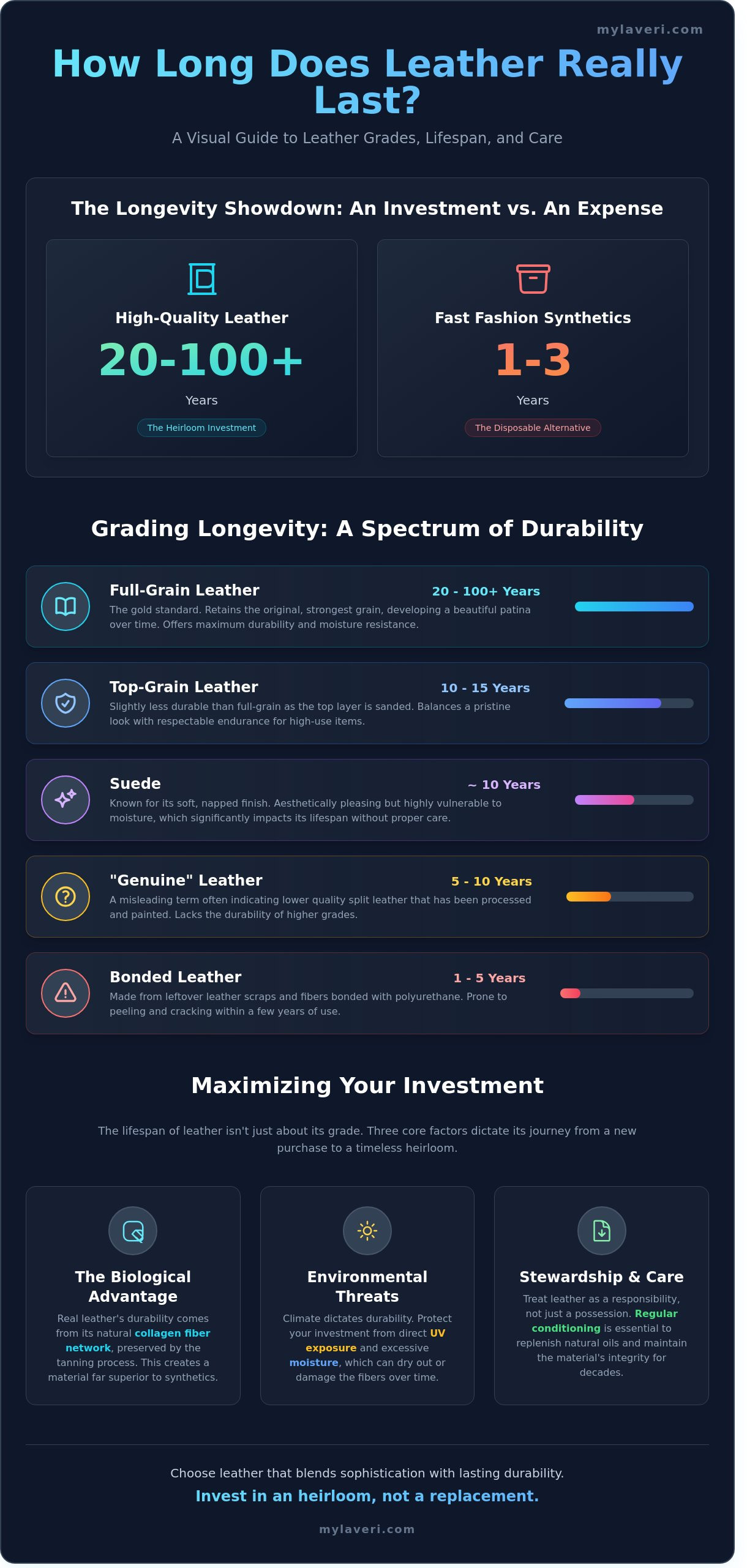
When considering how long does leather last, high-quality leather is a remarkable investment, capable of enduring anywhere from 20 to 100 years with the right care. This longevity stands in stark contrast to fast fashion alternatives, often made from synthetics, which typically degrade within 1 to 3 years. The durability of leather not only reflects its quality but also introduces the concept of the 'Heirloom Factor,' where premium handcrafted goods often become cherished family possessions passed down through generations.
One of the most compelling aspects of leather is its ability to improve over time. As leather ages, it develops a unique patina, enhancing its character and beauty rather than degrading its appearance. This natural aging process makes leather one of the few materials that gain a personal touch through daily use.
The 'Lifetime' Myth vs. Reality
The term 'lasting a lifetime' often misleads consumers into thinking that all leather goods maintain their original appearance indefinitely. In reality, the lifespan of leather depends on various factors, including daily use, maintenance, and the specific type of item. For instance, a sturdy, well-constructed leather trunk from the early 20th century may still be functional, but it will look markedly different from a 100-year-old wallet that has seen daily wear. The trunk’s structural integrity remains intact, while the wallet's aesthetic has transformed with the years.
The Biological Advantage: Why Real Leather Endures
The secret to leather's remarkable durability lies in its composition. The collagen fiber network found in animal hides provides a natural strength that synthetic materials cannot replicate. During the tanning process, these fibers are treated to prevent organic decay, effectively 'freezing' them in a state that can last for generations. This process serves as a bridge between raw hide and a permanent, beautiful material that, when cared for properly, can stand the test of time.
Grading Longevity: From Full-Grain Heirlooms to Bonded Blends
The grade of leather is the most significant predictor of its lifespan. Understanding the differences between various types of leather can help you make informed choices about your purchases. Cheaper options, such as split leathers, lose their structural 'top' layer during processing, leading to quicker degradation compared to higher-grade alternatives. Labels like 'Genuine Leather' may sound appealing, but they often indicate a blend that lasts only 5 to 10 years. In contrast, brands like Laveri prioritize full-grain and top-grain leathers for their exceptional durability and longevity.
Full-Grain Leather: The Gold Standard for 20+ Years
Full-grain leather is considered the gold standard, capable of lasting over 20 years with proper care. The reason lies in its ability to retain the original grain, preserving the strongest fibers that provide structural integrity. The tight grain of full-grain leather resists moisture and environmental wear, ensuring that your investment stands the test of time. To ensure you're purchasing genuine quality, it’s crucial to identify genuine leather before making a purchase.
Top-Grain and Suede: Balancing Aesthetics and Endurance
Top-grain leather, while slightly less durable than full-grain, still offers a respectable lifespan of 10 to 15 years, especially in high-use professional environments. The sanding process that removes imperfections also impacts its long-term resistance. Suede, on the other hand, presents a unique vulnerability to moisture, which can significantly shorten its lifespan to around 10 years. Thus, while suede may be aesthetically pleasing, it may require more careful maintenance to ensure its longevity.
- Full-Grain Leather: Lasts 20+ years, retains original grain.
- Top-Grain Leather: Lasts 10-15 years, slightly less durable.
- Suede: Lasts around 10 years, sensitive to moisture.
Understanding how long does leather last starts with recognizing the type of leather you are investing in. By choosing full-grain or top-grain options, you align yourself with products that not only offer visual appeal but also exceptional durability. For those looking to invest in quality leather that stands the test of time, consider exploring the offerings at Laveri for premium selections designed to elevate your style while ensuring longevity.
Environmental Threats: Why Climate and Care Dictate Durability
There's a common misconception that leather is indestructible, able to withstand various environmental conditions without consequence. This belief can lead to disappointment when leather goods show signs of wear far sooner than expected. The truth is that the longevity of leather is significantly influenced by climate and care practices.
One of the most detrimental factors is UV exposure. Prolonged sunlight can deplete the natural oils within the hide, leading to dryness and cracking. This deterioration not only affects appearance but also reduces the leather's overall lifespan. Similarly, physical load plays a critical role in leather durability; overstuffing bags can result in permanent stretching of the fibers, compromising their structure and integrity.
A lesser-known issue is 'dry rot,' which occurs when leather is neglected, particularly in arid climates. This phenomenon can lead to brittleness, making the leather prone to tearing and fraying. Understanding these environmental threats is essential for any leather owner who wants to answer the question, "how long does leather last?" with confidence.
This focus on material resilience is equally important when selecting items for your home's exterior. Just as leather requires protection from the sun, high-quality garden furniture and outdoor accessories from Living Chic are crafted to handle environmental exposure while retaining their style and functionality.
The UAE Factor: Heat, Humidity, and Luxury Leather
In regions like Dubai, the unique climate poses specific challenges for leather care. Extreme heat and humidity can wreak havoc on luxury leather items. High humidity levels can lead to mold growth, while excessive heat often causes the leather to crack. To protect your leather goods, transition them carefully from air-conditioned spaces to outdoor conditions. Consider using breathable dust bags for storage and avoid exposing leather to direct sunlight for prolonged periods.
Friction and Daily Wear: Where Bags Fail First
Daily use inevitably introduces friction, which can be particularly damaging at high-stress points like handles, straps, and corners. These areas wear down faster, often leading to unsightly scuffs and tears. Interestingly, hardware such as zips and buckles can sometimes outlast the leather itself, highlighting the need for quality components in leather goods. Opting for handcrafted stitching can help prevent seam unraveling, ensuring your investment withstands the test of time.
By understanding the environmental threats to leather and implementing proper care techniques, you can significantly extend the life of your leather products, making them a worthwhile investment. After all, well-maintained leather does not just last longer; it also ages beautifully, enhancing its character and charm over time.
Maximising Your Investment: Maintenance Steps That Add Decades
Investing in leather is not just about acquiring a luxurious item; it’s about embracing a stewardship philosophy. As a caretaker of your leather goods, you have the power to extend their lifespan significantly. Understanding how long does leather last is essential, and with the right maintenance, you can ensure that your pieces remain elegant and functional for decades.
Conditioning your leather is akin to discovering the 'fountain of youth' for its fibers. Regular conditioning replenishes the natural oils that keep leather supple and prevents it from drying out. Conversely, using household chemicals like dish soap or alcohol can be detrimental. These substances can strip the leather of its natural oils, leading to cracks and premature aging. Always opt for professional-grade care products, which are specifically formulated to nourish and protect premium hides, unlike generic budget waxes that may offer only a temporary fix.
Cleaning and Conditioning Intervals
Establishing a cleaning and conditioning routine is crucial for maintaining the integrity of your leather. For casual-use items, a thorough clean and condition every three to six months is usually sufficient. However, daily-use items, such as handbags or wallets, should be conditioned every month to combat the wear and tear they experience. Refer to our guide on how to clean a leather bag for step-by-step instructions.
- Signs your leather is 'thirsty' include:
- Loss of flexibility
- Lightening of color
The Science of Proper Storage
Proper storage of your leather items is just as important as regular maintenance. Using breathable dust bags is non-negotiable for luxury items, as they protect against moisture and dust without trapping humidity. Additionally, avoiding 'shape-memory' issues requires careful positioning during long-term storage; ensure that items are not overly compressed, as this can lead to unsightly creases.
For comprehensive insights, check out our full guide on how to store leather bags.
By embracing these maintenance steps, you not only preserve the beauty of your leather but also maximize your investment. A little care goes a long way in ensuring that your leather goods remain timeless and elegant. Invest in proper maintenance today to enjoy your leather treasures for years to come. For more premium leather care advice, explore our resources.
The Laveri Standard: Handcrafted to Outlast the Decades
When exploring the question of how long does leather last, the quality of the materials and craftsmanship plays a pivotal role. At Laveri, we meticulously select premium hides that ensure a superior 'starting' lifespan for all our leather products. This commitment to quality means our bags and wallets not only look exquisite but also stand the test of time.
Our artisan craftsmanship is another cornerstone of durability. Unlike mass-produced alternatives, our skilled artisans reinforce stress points in each piece, ensuring it can withstand daily use. This attention to detail transforms a simple bag into a lifetime companion, capable of aging beautifully while maintaining its structural integrity.
Timeless designs also contribute to the longevity of our leather goods. A Laveri bag is crafted not just for the moment but for the future, ensuring it remains stylish as long as the leather lasts. This blend of classic aesthetics with modern functionality exemplifies our commitment to 'Practical Luxury,' merging beauty with extreme durability.
From Artisan Hands to Your Wardrobe
The difference between mass-produced machine stitching and skilled handcrafting is profound. Our artisans employ techniques that enhance durability while providing a unique touch to each piece. Additionally, the selection of quality hardware prevents the premature 'retirement' of a bag, allowing you to enjoy your investment for many years to come. For a deeper dive into our craftsmanship, check out the Definitive Guide to Leather Bags.
Choosing Your Lifetime Companion
When selecting a bag or wallet, consider your expected activity level. For everyday use, look for a durable design with reinforced stitching. If your lifestyle requires versatility, opt for a multi-functional bag that can adapt to various occasions. Remember, investing in quality over quantity will ultimately save you money and enhance your style. Ready to find your perfect piece? Explore our collection of handcrafted leather bags designed for a lifetime.
Embrace Timeless Quality Today
Understanding how long does leather last empowers you to make informed choices for your wardrobe and lifestyle. From the durability of full-grain leather to the significant impact of care and maintenance on longevity, it's clear that investing in quality pays off. By following proper maintenance steps, you can extend the life of your leather goods for decades, ensuring they remain a cherished part of your collection.
Discover the elegance and durability of Laveri's handcrafted leather products. Our commitment to using 100% full grain genuine leather ensures that you receive only the finest quality. Experience the sophistication of timeless craftsmanship that not only looks good but lasts.
Ready to invest in pieces that will stand the test of time? Explore our premium leather collection today and step into a world of luxury and longevity.
Frequently Asked Questions
Is it worth repairing an old leather bag or should I buy a new one?
Repairing an old leather bag can be worth it, especially if it holds sentimental value or is made from high-quality materials. Much like how homeowners prolong the life of their fridges and freezers by finding parts at Hvidevaredele.dk, skilled artisans can often restore leather bags to their former glory, extending their lifespan by several years. However, if the bag is made from lower-quality leather or has significant damage, investing in a new, premium leather bag may be a more practical choice.Can real leather last 100 years?
Yes, real leather can last up to 100 years or more with proper care and maintenance. Full-grain leather, in particular, is known for its durability and ability to age beautifully. Regular conditioning and protection from extreme elements can significantly enhance its longevity, making it a worthwhile investment for those seeking timeless quality.
Does 'genuine leather' last as long as full-grain leather?
No, genuine leather generally does not last as long as full-grain leather. Genuine leather is often made from lower-quality hides and is more prone to wear and tear. Full-grain leather, on the other hand, retains the entire grain of the hide and is more durable, making it a superior choice for longevity.
What happens to leather if you never condition it?
If leather is never conditioned, it can become dry, brittle, and prone to cracking. Without regular conditioning, the natural oils in the leather diminish, leading to deterioration over time. To maintain its appearance and durability, it's essential to condition leather items at least every six months.
How can I tell if my leather is starting to rot?
Signs of rotting leather include a foul smell, discoloration, and visible mold or mildew spots. If the leather feels sticky or has an unusual texture, it may also indicate decomposition. Addressing these issues promptly is crucial to prevent further damage and preserve the integrity of your leather goods.
Does the sun significantly shorten the life of a leather bag?
Yes, prolonged exposure to sunlight can significantly shorten the life of a leather bag. UV rays can cause fading, drying, and cracking, weakening the leather over time. To protect your investment, store leather bags in a cool, dark place when not in use and avoid direct sunlight during everyday wear.
How many years does a leather wallet typically last?
A high-quality leather wallet can last anywhere from 5 to 10 years, depending on usage and care. Wallets made from full-grain leather often endure longer due to their durability. Regular conditioning and proper storage can further extend the lifespan, making it a practical investment for daily use.
Can rain permanently ruin a premium leather bag?
Rain can damage a premium leather bag, but it doesn't necessarily ruin it permanently. If water is wiped off promptly and the bag is allowed to dry naturally, it can often recover without lasting effects. However, repeated exposure to moisture without proper treatment can lead to stains or mold, compromising the leather's integrity.
